Planning Poker online
Estimate stories with your team in real time. Everyone votes in secret, cards flip at once, and you talk about the gaps. No sign-up, no ads, free for teams up to 15.
How it works
- Create a room. Type your name, pick a deck and you get a private link.
- Share the link. Drop it in your Zoom, Meet or Slack chat. Teammates join with just a name.
- Vote in secret. The host types the story, everyone picks a card. Others only see that you voted, not what.
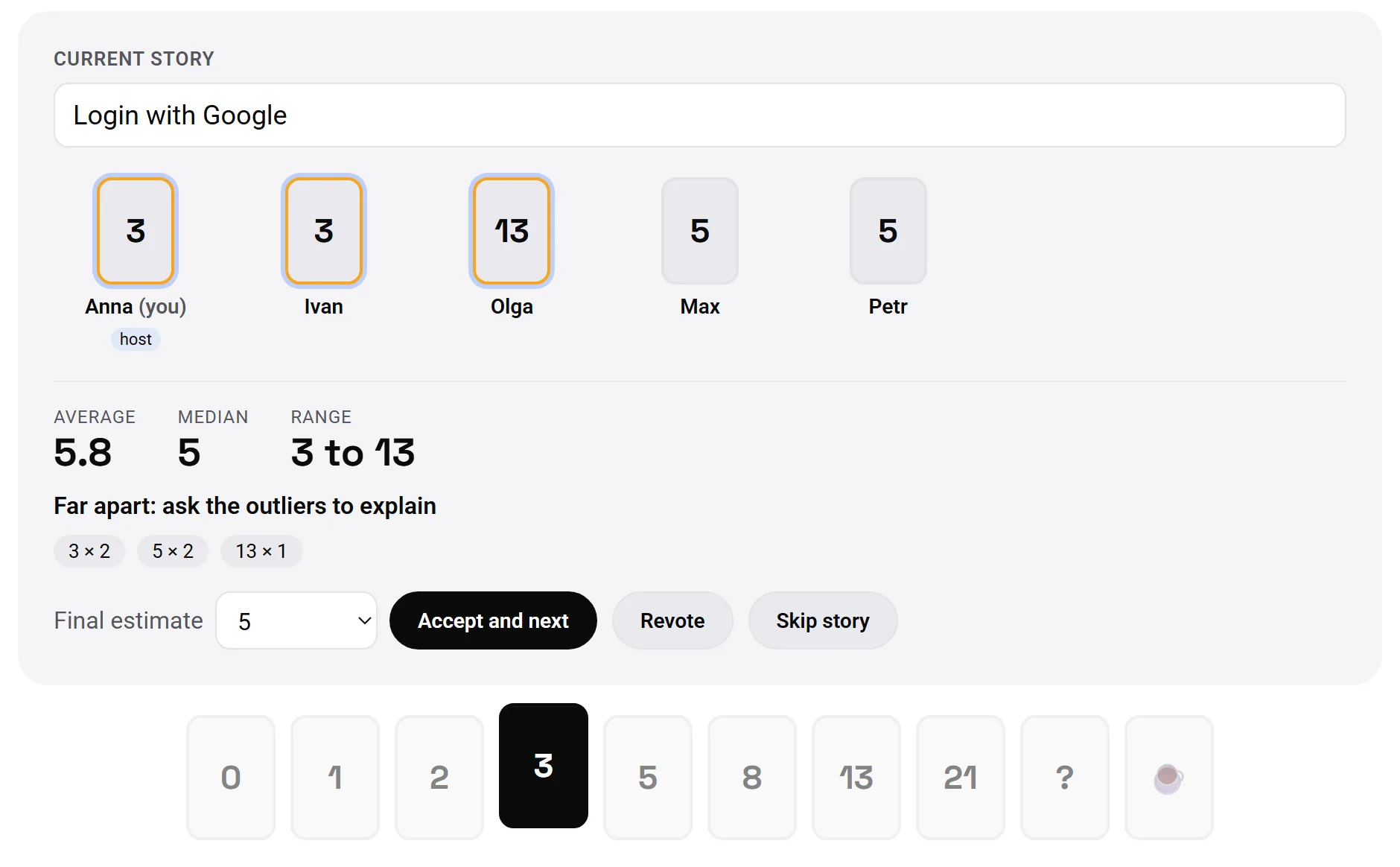
- Reveal and discuss. Cards flip at once with the average, median and spread. Far-apart votes are highlighted, so the people behind them explain their reasoning.
- Accept and move on. Save the estimate, go to the next story, and export the whole session as CSV at the end.
What is Planning Poker?
Planning Poker is an estimation technique used by Scrum and other agile teams. You will also see it called Scrum Poker or pointing poker. Instead of guessing hours, the team sizes each story in relative units called story points: a story worth 8 is roughly twice the work of a story worth 3.
The point of the game is to avoid anchoring. When estimates are said out loud, the first number usually wins: a senior developer says "two", and the junior who spotted a hidden migration stays quiet. With hidden cards and a simultaneous reveal, every opinion counts, and a 3 next to a 13 starts the conversation the team actually needs.
The Fibonacci deck grows in uneven steps on purpose. Big stories carry more uncertainty, so arguing whether something is a 14 or a 15 makes no sense, while 13 versus 21 is a real choice. The ? card means "I don't understand the story yet", and the coffee card asks for a break.
Fibonacci, T-shirt sizes or powers of two?
Fibonacci is the most common choice for story points in sprint planning. The gaps between cards force a choice instead of hair-splitting, and the numbers add up, so you can compare a sprint's total with the team's velocity.
T-shirt sizes (XS to XXL) suit early backlog grooming and roadmap talks, when stories are still rough and nobody wants to commit to a number. Sizes are easy for non-technical people to read, but they don't add up, so convert them to points before you plan a sprint.
Powers of two (1, 2, 4, 8, 16, 32) work for teams that think in doublings: "this is twice as big as that". The steps grow even faster than Fibonacci, which makes oversized stories stand out quickly.
How to run a good estimation session
- Agree on a reference story. Pick one finished story everybody remembers and call it a 3. Every new estimate is a comparison with it, which keeps the scale stable from sprint to sprint.
- Let the outliers talk first. When votes spread from 3 to 13, the lowest and the highest voters explain their thinking. Usually one of them knows something the rest missed.
- Don't average away a disagreement. A median of 5 from votes of 2 and 13 hides the real question. Discuss, then vote again.
- Revote once, then decide. If the second round still splits, take the higher estimate or split the story. A third round rarely changes anything.
- Split anything above 13. A 21 is a signal that the story is too big to estimate honestly, not a number to plan with.
- Keep the product owner as an observer. They answer questions about the story but don't vote on the effort.
FAQ
Is Planning Poker the same as Scrum Poker?
Yes. Planning Poker, Scrum Poker and pointing poker are names for the same technique: everyone estimates a story in secret and the cards are revealed at once.
Is this Planning Poker tool free?
Yes. It is free, with no ads, no paid plan and no limit on the number of stories you estimate.
Do I need to create an account?
No. The host enters a name and gets a room link. Teammates open the link, type their name and start voting.
How many people can join a room?
Up to 15 people per room, voters and observers together. That covers a typical Scrum team with room to spare.
How long does a room last?
A room stays open while people use it and is deleted 12 hours after the last activity, together with names, votes and history.
Which card decks are available?
Fibonacci (0, 1, 2, 3, 5, 8, 13, 21), T-shirt sizes (XS to XXL) and powers of two (0 to 32). Every deck also has a ? card and a coffee break card.
What happens if the host drops off the call?
If the host has been offline for two minutes, any participant can take over the host role with one click, and the session continues.
Can I export the estimates?
Yes. The session history can be downloaded as a CSV file or copied as plain text to paste into Jira, Linear or Trello.
Does it work on a phone?
Yes. The room adapts to small screens, so teammates can vote from a phone while the call runs on a laptop.
Team spread across time zones? Use the free time zone meeting planner to find a slot for the estimation session.
Backlog bigger than your team?
This tool is made by ISTRALLEN. We build backends, payment and API integrations, and production AI features for product teams.